Measure what your station uses
Measure receive and transmit current and estimate how much energy a check-in requires.
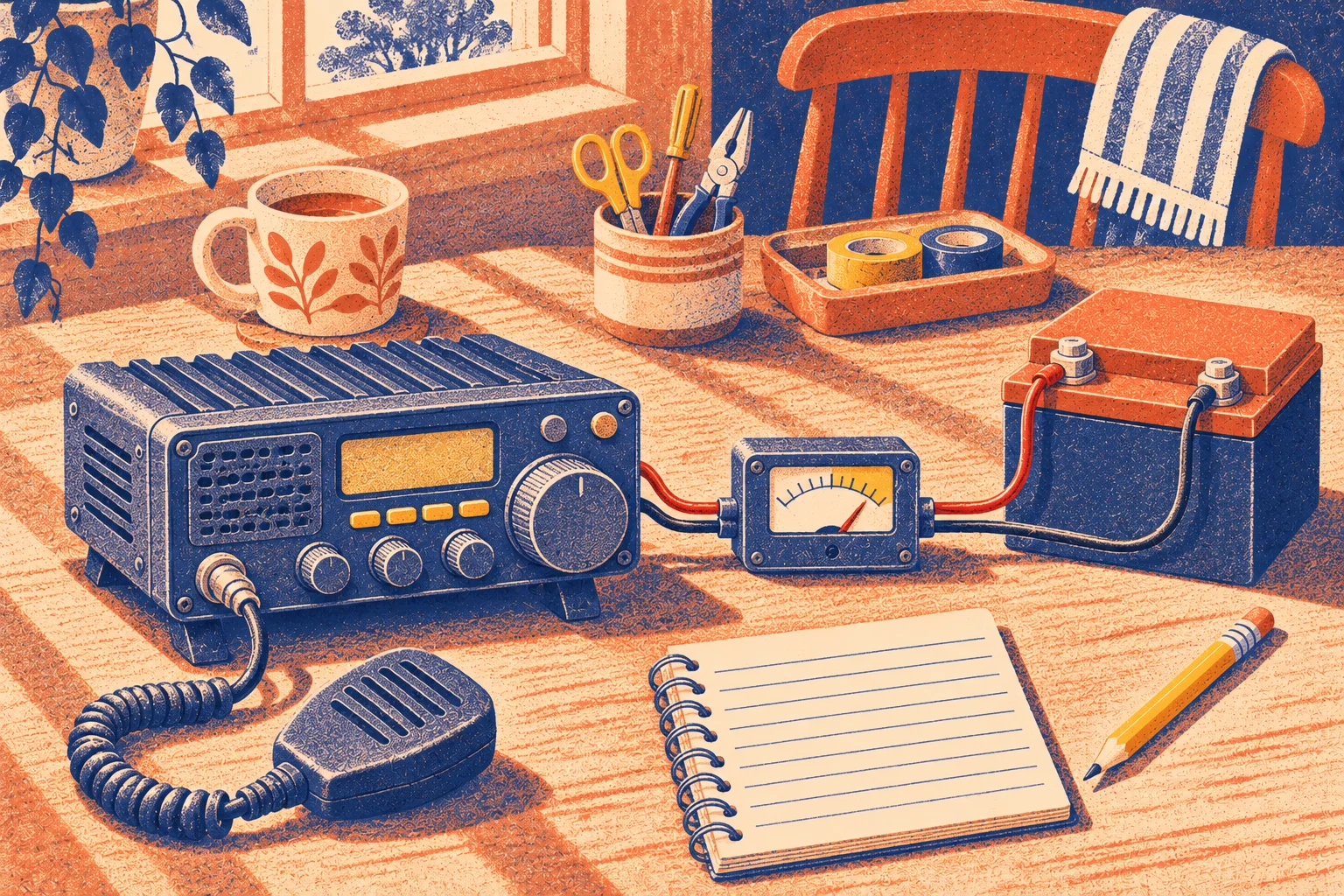
A home station may run all evening on a battery when you mostly listen, then draw much more during an active net. Measure the station you actually need. Include the radio and any accessories that must stay on for the plan to work.
Measure receive and transmit separately
Use a suitably rated inline DC meter or a power monitor that measures the full load. Follow the equipment manuals for connection and polarity, and leave the existing overcurrent protection in place. Record the radio’s receive current, transmit current at your usual output, and the voltage at the radio during transmit. If you use an HF digital setup, measure it during a typical message exchange and follow the radio’s duty-cycle guidance. Home Base · Radio on Wheels · Set up the radio and computer for digital HF
Work one example
A radio draws 0.6 A on receive and 9 A on transmit. A net keeps it transmitting for about 10% of the time. The average is (0.6 × 0.90) + (9 × 0.10) = 1.44 A. An accessory drawing 0.3 A continuously brings the total to 1.74 A. Eight hours at that average needs about 14 Ah at the battery voltage, assuming the current figures were measured on that same DC supply. Size the wiring, fuse protection, and power source for the actual load and peaks, including the 9 A transmit draw.
For an inverter, DC converter, or loads at different voltages, compare energy in watt-hours. Measure at the battery when possible so conversion losses are included. The next article uses the measured demand to choose a battery and reserve.
Transmit
Have a partner run a short check-in with the station on its normal power source. Time how long you transmit and log receive current, transmit current, and voltage under load. Estimate energy for your planned listening windows. Repeat with the busiest realistic schedule and keep both estimates.