FRS, GMRS, MURS, or ham radio?
Choose a radio service for your family or neighborhood, then test it from the places that matter.
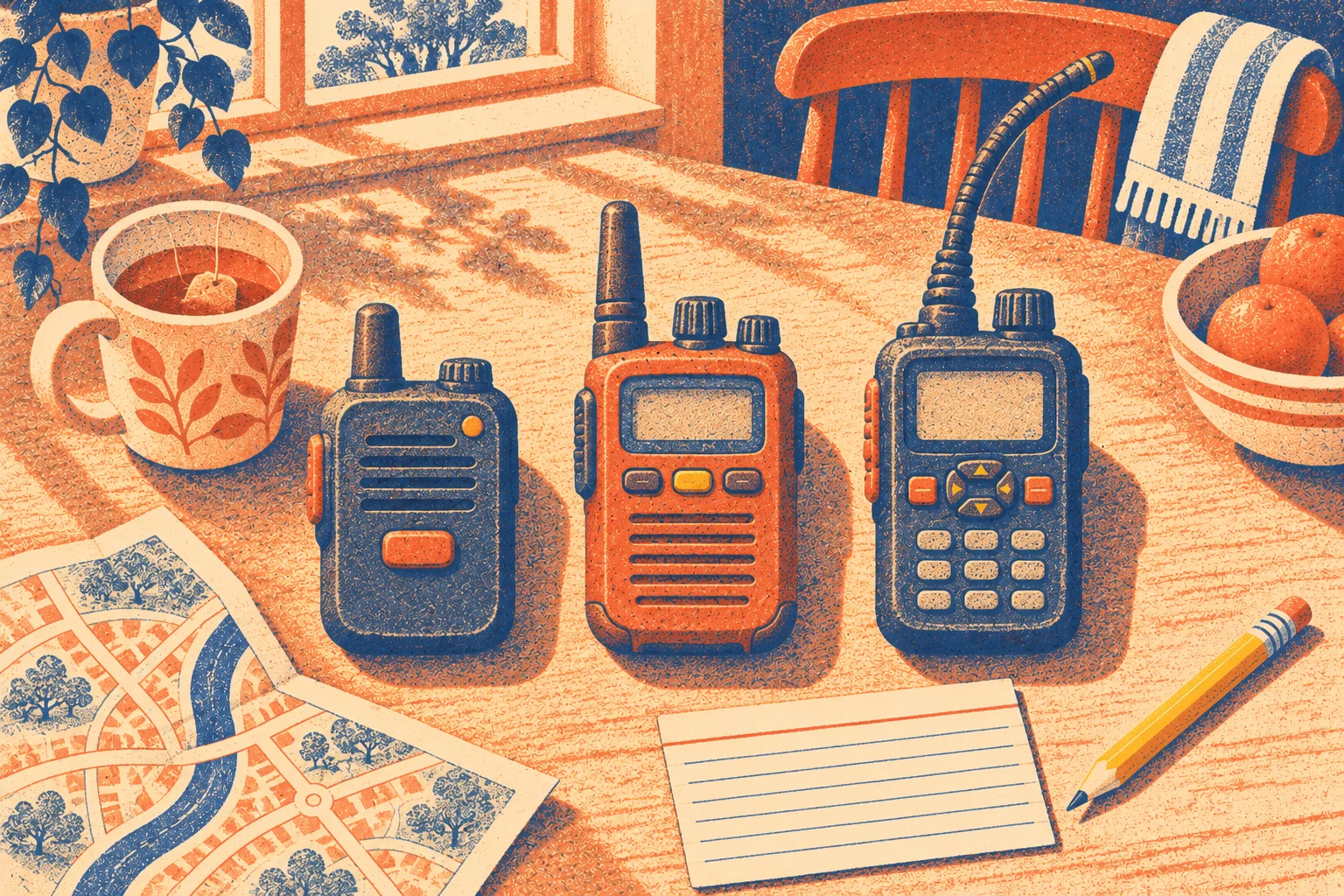
If you’re setting up a check-in between two homes, start with who needs to talk and where they’ll be. In the U.S., FRS and the Multi-Use Radio Service (MURS) give groups two options for direct voice without individual licenses. FRS uses UHF, while MURS uses VHF. GMRS adds repeater options for authorized operators. Amateur radio, often called ham radio, gives licensed operators more bands and modes to work with. The right choice depends on who can transmit and which paths work in both directions.
Equipment for this guide
I may earn a commission from purchases made through the BTECH links in this section.
- BTECH FRS-A1 two-pack — Two FRS handhelds for direct check-ins on the 22 standard channels.
- BTECH GMRS-V2 handheld — A GMRS handheld with direct and repeater channels for authorized operators.
- BaoFeng BF-F8HP handheld — The original dual-band analog FM model used in the amateur radio series.
Compare the four services
| FRS | GMRS | MURS | Amateur radio | |
|---|---|---|---|---|
| Who can transmit independently? | Eligible users with certified FRS radios can operate without applying for an individual FCC license. | A GMRS licensee can operate certified GMRS equipment and authorize eligible immediate family to use their stations. Neighbors generally need their own GMRS authorization. | Eligible users can operate MURS-certified radios without applying for an individual FCC license. | Each transmitting station needs an authorized amateur control operator. A GMRS license provides no amateur privileges. |
| Where do you tune? | 22 numbered UHF channels around 462 and 467 MHz. | Shares the 22 FRS frequencies, with channel-specific limits, and has eight additional repeater input frequencies. | Five shared VHF frequencies near 151 and 154 MHz. | Common handheld bands are 2 meters (144–148 MHz) and 70 centimeters (420–450 MHz in the U.S.). Frequency and mode privileges depend on the rules and location. |
| How do you make contact? | Direct radio to radio. | Direct or through a GMRS repeater that you’re allowed to use. | Direct radio to radio. | Direct or through an amateur repeater. Other amateur bands and equipment support additional uses, including HF contacts beyond the local area. |
FRS, GMRS, and MURS are radio services with defined channels. Amateur radio is a service with multiple bands. The familiar 2-meter and 70-centimeter bands are frequency ranges, so two ham operators still need to agree on an appropriate frequency and mode. FRS channels · GMRS channels · MURS channels · Amateur bands
Choose for the people on your plan
FRS for a nearby check-in. If family members and neighbors can reach each other directly, start with certified FRS radios on an agreed channel. For mixed equipment, certified FRS and GMRS radios can exchange voice on a shared direct channel. Use the same channel and turn off tone or code filtering for the first test. FRS and GMRS for families and neighborhoods · FRS and GMRS interoperability rule
GMRS when a tested repeater fills a gap. If a hill or buildings block a direct path, an accessible repeater may help. Check the owner’s access policy and test both locations. Each GMRS operator needs proper authorization and must follow the call sign rules. Keep FRS users on the shared direct channel and agree when everyone will switch there. Add a local GMRS repeater · GMRS licensing and access · GMRS identification
MURS for a direct VHF check-in. If both ends have MURS-certified radios, try a direct check-in on one of the five shared frequencies: 151.820, 151.880, 151.940, 154.570, or 154.600 MHz. Write down the frequency along with the radio’s channel label. MURS has a 2-watt transmitter output limit, and repeaters and signal boosters are prohibited. MURS uses different frequencies from FRS and GMRS, so every household using this path needs access to a MURS radio. Listen before transmitting and test both directions from the places you’ll use. MURS rules · FCC licensing rules
Ham radio when the people on the link are licensed. A pair of licensed operators can practice local simplex or use an amateur repeater. If only some households have a ham operator, keep a shared check-in method everyone can use. Use certified radios for FRS or GMRS transmissions. The BaoFeng BF-F8HP is the amateur handheld used in our series. BaoFeng BF-F8HP series · Amateur control operator rule · FRS certification · GMRS certification
On the card
Write down the service, channel or frequency, and whether you’re using a repeater. Include any tone settings, who calls first, when to listen, and how long to wait before switching to the backup. For each path, record the actual locations where both people heard and confirmed a message. Terrain, buildings, and where you stand can change the result, so test from the kitchen or porch you’ll actually use. Test handheld range and relay through a neighbor · Build and print your plan
Transmit
Pick two places from your plan and start with a service both people can use. At the agreed time, send a short check-in with your location and next check-in time. Have the other person repeat the time back, then trade roles. Run it again with one person withholding their reply on purpose. Both switch to the backup at the time on the card and confirm contact there. If a path fails, write down where it failed and try the next agreed method.